
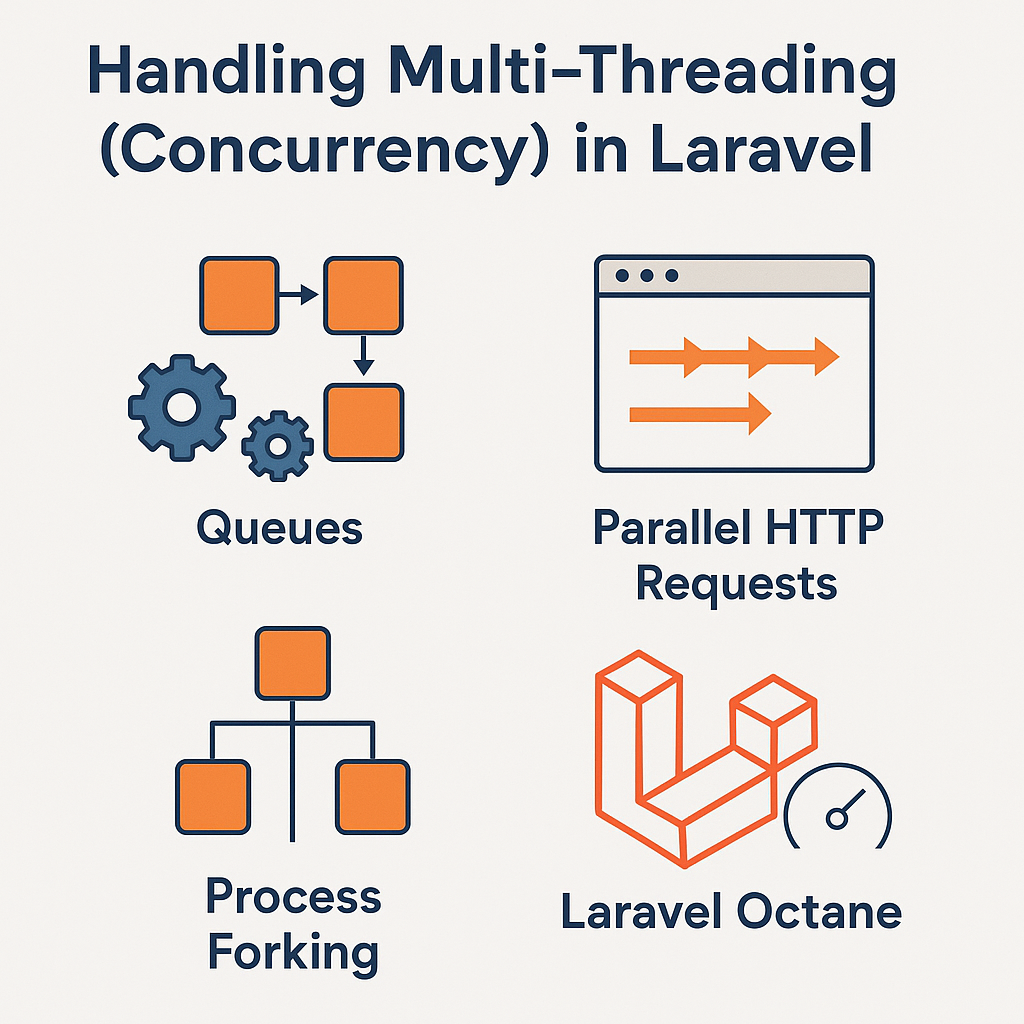
How to Handle Multi-Threading (Concurrency) in Laravel
🤔 What Does “Multi-Threading” Mean in PHP?
PHP itself is single-threaded, but Laravel provides several asynchronous and concurrent programming patterns through:
-
Queues (for background jobs)
-
Event broadcasting
-
Process forking (via
pcntl_fork) -
Parallel HTTP requests using Guzzle
-
Laravel Octane (Swoole/RoadRunner) for true parallelism
🧵 1. Using Laravel Queues for Asynchronous Tasks
Laravel queues are the most Laravel-native way to defer time-consuming operations like:
-
Sending emails
-
Processing uploaded files
-
Generating reports or PDFs
Example:
Define your job using:
You can then run the queue worker:
✅ Tip: Always use queues for heavy background processing to boost Laravel performance and user experience.
🧪 2. Running Parallel HTTP Requests (With Guzzle)
For microservice or API-heavy apps, Laravel can make parallel API calls using Guzzle Promises:
This reduces waiting time compared to sequential requests — great for performance!
⚙️ 3. Process Forking with pcntl_fork
For advanced concurrency in CLI scripts or daemons, you can use pcntl_fork() in PHP (CLI only):
Use this carefully — it’s powerful but comes with caveats (memory, portability, error handling).
⚡ 4. Real Parallelism with Laravel Octane
If you want true performance gains with concurrent request handling, Laravel Octane is your best choice.
Install it via:
Then serve your app using Swoole or RoadRunner:
Laravel Octane boosts performance by keeping your app in memory between requests, enabling parallel task handling, and removing bootstrapping overhead.
✅ Best Practices for Laravel Concurrency
-
Use queues as your first step toward asynchronous operations
-
Leverage Laravel Octane for high-performance, concurrent web request handling
-
For parallel external requests, use Guzzle async
-
Avoid low-level
pcntl_forkunless absolutely needed in CLI apps
🧠 Final Thoughts
While PHP is not a multi-threaded language by nature, Laravel provides multiple ways to handle concurrency effectively. Whether through queues, parallel API calls, or Octane, you can significantly boost performance in your Laravel applications.
Implementing concurrency in Laravel doesn’t require reinventing the wheel—just the right tools and a bit of planning.